



IELTS vs PTE vs TOEFL: Which English Test Should Pakistani Students Take?
IELTS vs PTE vs TOEFL for Pakistani students: format, scoring, country acceptance, 2026 fees in Pakistan, difficulty for Urdu speakers, and a decision matrix.
 Ali Khan
Choosing between IELTS, PTE, and TOEFL is a bigger decision than it looks. Pick the wrong one and you can hit avoidable friction at the admission, scholarship, or visa stage. Pick the right one and your whole application pipeline flows more smoothly.
This guide gives Pakistani students an honest comparison of cost, difficulty, acceptance, and test experience, not marketing claims. By the end you will know which test fits your country choice, budget, and personal strengths.
The Three Tests: Which One Do You Need?
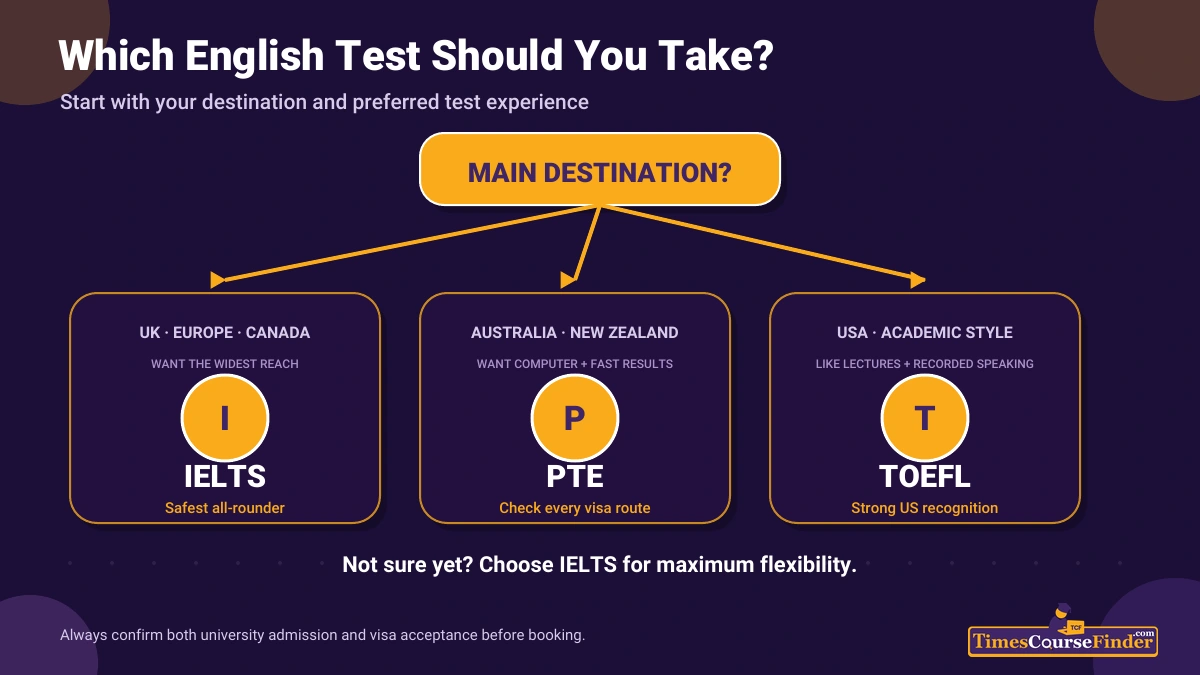
Universities and immigration authorities widely accept all three tests. The best choice depends on your destination, test-taking preferences, budget, and strengths.
|
Test |
Full name |
Best for |
Format |
|
IELTS |
International English Language Testing System |
UK, Australia, New Zealand, Germany, Canada |
Computer-based (paper discontinued in Pakistan) |
|
PTE |
Pearson Test of English Academic |
Australia, New Zealand, UK, Canada |
Fully computer-based |
|
TOEFL |
Test of English as a Foreign Language |
USA, Canada, international universities |
Internet-based (iBT) |
In short: choose IELTS for the most widely accepted option and if you are comfortable with a face-to-face speaking interview; choose PTE if you prefer a fully computerised exam and the fastest results; choose TOEFL if you are targeting US universities and are comfortable with an academic-style test.
Quick Recommendation by Destination
|
Destination |
Recommended test |
Why |
|
Germany |
IELTS or TOEFL |
Most German universities accept both; Pakistani students more commonly submit IELTS |
|
United Kingdom |
IELTS |
Widely accepted by universities and UK visa authorities |
|
Australia |
PTE or IELTS |
Universities accept both for admissions and visa applications |
|
Canada |
IELTS |
The most commonly accepted test for study permits and university admissions |
|
United States |
TOEFL or IELTS |
TOEFL remains popular, though IELTS acceptance has grown significantly |
|
New Zealand |
PTE or IELTS |
Universities and immigration authorities recognise both |
|
Ireland |
IELTS |
Accepted by almost all Irish universities |
|
Europe (general) |
IELTS |
The most commonly accepted English test across European universities |
Format Comparison
Format matters because it decides how tired you feel, how you manage time, and whether the test suits your style.
IELTS Academic (about 2.5 hours plus Speaking)
Four modules: Listening (about 30 minutes, 4 sections, 40 questions, mixed accents); Reading (60 minutes, 3 academic passages, 40 questions); Writing (60 minutes: Task 1 describing a graph, chart, process, or map in at least 150 words, and Task 2 an essay of at least 250 words); and Speaking (11 to 14 minutes, face-to-face with a human examiner, across Part 1 questions, a Part 2 cue card, and a Part 3 discussion). In Pakistan the test is now computer-delivered, though the Speaking test remains a real conversation with an examiner.
PTE Academic (about 2 hours, fully computer-based)
A single continuous computer-based test with headphones and a microphone. Speaking and Writing are combined (Read Aloud, Repeat Sentence, Describe Image, Re-tell Lecture, Summarise Written Text, Write Essay), followed by Reading (multiple choice, re-order paragraphs, fill in the blanks) and Listening (Summarise Spoken Text, multiple choice, fill in the blanks, Highlight Incorrect Words, Write from Dictation). Scoring is AI-based.
TOEFL iBT (computer-based, four sections)
A computer-based test with Reading (academic passages), Listening (lectures and campus conversations), Speaking (four recorded tasks, independent and integrated), and Writing (an integrated read-listen-write task and an independent essay), scored by a mix of AI and human raters. Note that ETS changed the TOEFL format and length in 2026, so confirm the current structure and duration on the official ETS page before you book.
Scoring System Comparison
IELTS: 0 to 9 band scale
IELTS uses a 0 to 9 band scale with whole and half bands. You get a band for each skill, and the overall band is the average of the four, rounded to the nearest half band. Many universities ask for 6.0 to 6.5 overall; more competitive programmes want 7.0, sometimes with no skill below 6.0 or 6.5.
PTE Academic: 10 to 90 scale
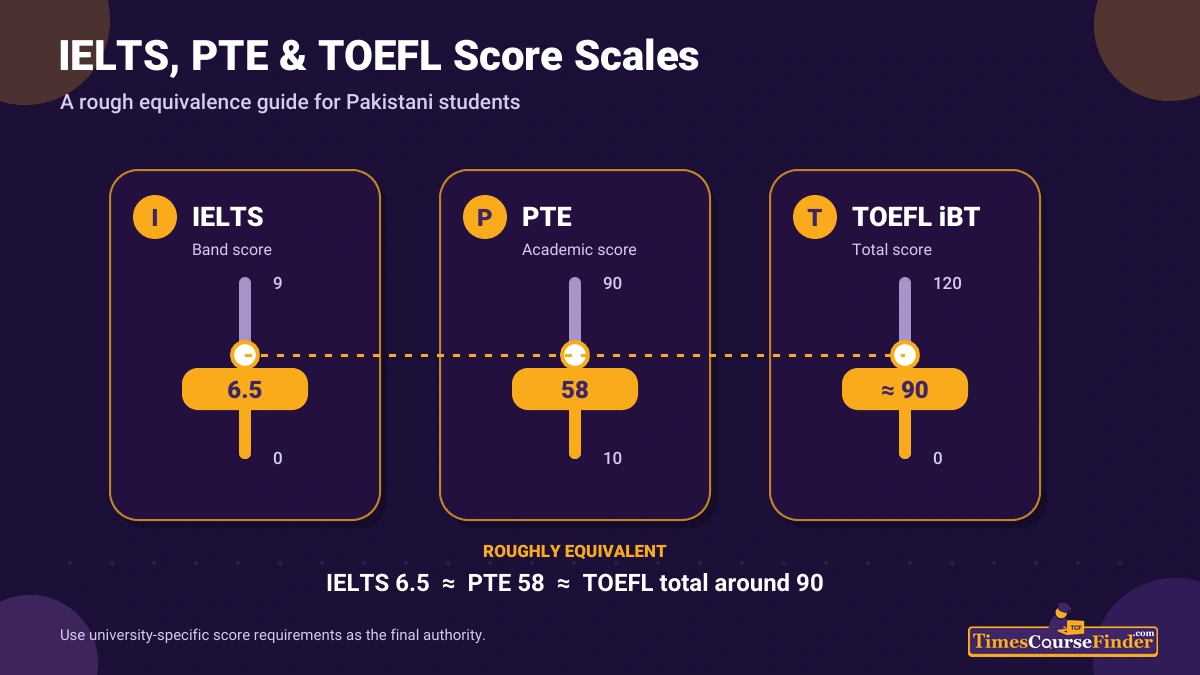
PTE scores you from 10 to 90 in single-point steps, with an overall score plus individual skill scores. Universities usually state requirements in PTE points but often provide equivalence tables (for example, PTE 58 is roughly IELTS 6.5, and PTE 65 is roughly IELTS 7.0).
TOEFL iBT: total score
TOEFL iBT gives a section score for Reading, Listening, Speaking, and Writing, and a total. Universities usually set a minimum total and sometimes minimum section scores. Many advisors share equivalence ranges, so a TOEFL total near 90 aligns roughly with an IELTS 6.5 to 7.0. Because ETS revised the test in 2026, confirm the current scoring scale your university accepts.
Country Acceptance
The biggest factor for Pakistani students is whether the target country accepts the score for both admissions and visas.
USA
- TOEFL iBT has been the traditional US standard for decades.
- IELTS Academic is widely accepted by US universities and treated as equivalent to TOEFL for admissions.
- PTE Academic is also accepted by many US institutions, though less widely than IELTS and TOEFL. If your focus is the US, TOEFL or IELTS is the safest choice.
UK
- For the UK student visa, many routes list IELTS for UKVI (Academic) as the standard Secure English Language Test (SELT).
- Most UK universities accept IELTS Academic for admission, and many accept PTE Academic, which also offers SELT variants for certain visa categories, though policies differ by institution and route.
- Some universities accept TOEFL for admission, but it may not cover SELT for all visa categories.
Canada
- IELTS Academic is the most common test for Canadian universities and colleges.
- PTE Academic has grown in admissions acceptance and, through PTE Core, is accepted by IRCC for economic immigration, though the university route uses PTE Academic.
- Many universities accept TOEFL iBT, especially for graduate programmes.
Australia
- Australian universities and immigration authorities accept both IELTS Academic and PTE Academic.
- Many institutions list PTE alongside IELTS, and some students prefer PTE for its fast results and fully computer-based format.
- Many universities also accept TOEFL iBT, but visa preferences vary, so confirm current rules.
Germany
- German universities commonly list IELTS Academic and TOEFL iBT as the main English options.
- IELTS is the most frequent test on English-taught programme pages, especially at public universities.
- Some institutions accept PTE Academic too, though less commonly than IELTS and TOEFL.
Cost Comparison in Pakistan
For many students, cost matters, but the gap between the three tests has narrowed. Note that PTE and TOEFL are charged in US dollars and paid by international card, so the exact rupee amount moves with the exchange rate, and local methods like Easypaisa, JazzCash, or bank transfer are not accepted for them. As of 2026, the three are broadly comparable:
|
Test |
Approximate 2026 fee in Pakistan |
Notes |
|
IELTS Academic / GT |
PKR 71,320 to 71,920 |
Paid locally; computer-delivered only in Pakistan |
|
IELTS for UKVI |
About PKR 72,000 |
For UK visa routes needing a SELT |
|
PTE Academic |
About PKR 62,000 to 80,000 |
USD-based (around USD 230 to 250); varies with the exchange rate |
|
TOEFL iBT |
About PKR 62,000 to 70,000 |
USD-based (around USD 220 to 250); confirm on ets.org |
So the old idea that PTE and TOEFL are clearly cheaper no longer holds; all three land in a similar band, and the deciding factors are acceptance, format, and result speed rather than price. Confirm the exact figure at booking, and take the TCF test-selector quiz to match your destination, budget, and strengths, then book a free counselling call to discuss universities and timelines.
Test Centre Coverage in Pakistan
Even a good test is unhelpful if you cannot find a nearby date. IELTS has the widest network, typically Karachi, Lahore, Islamabad, Rawalpindi, Faisalabad, Multan, Peshawar, and Quetta, with further locations depending on the schedule. PTE has good coverage in major centres (Karachi, Lahore, Islamabad, and sometimes Rawalpindi and other cities), while TOEFL centres are fewer and comparable to PTE in spread (mainly Karachi, Lahore, and Islamabad). Because networks change, check the official booking pages, filter by Pakistan and your city, and look at the next 4 to 8 weeks of dates.
Result Timeline Comparison
- IELTS: computer-delivered results usually arrive in about 3 to 5 days in Pakistan.
- PTE: the fastest turnaround, usually 24 to 48 hours, which is attractive for tight conditional-offer, CAS, or visa deadlines.
- TOEFL: results are usually available online in roughly 4 to 10 days, with score reports to universities adding a few more days.
If you are targeting US or Canadian universities, build a one to two week buffer into your timeline so you are not rushing.
Validity Period (All Two Years)
IELTS, PTE Academic, and TOEFL iBT scores are all valid for 2 years from the test date, after which most universities and immigration authorities want proof of your current English level. Whichever exam you choose, plan to take it within 6 to 12 months of your intended intake so the score stays valid through admission and visa stages.
Which Is Easier for Urdu Speakers?
There is no single easiest test, but patterns emerge for Urdu-speaking students depending on where your English is strong and how comfortable you are with technology and accents.
Listening
IELTS uses a mix of British, Australian, and other accents with straightforward question types, and many students find it manageable after a few weeks of accent practice. PTE uses shorter clips with intense timing and integrated tasks, which suits fast readers but is harder if you struggle to split attention. TOEFL uses long academic lectures, great if you enjoy academic topics but tiring if long recordings and note-taking wear you down.
Speaking (human vs computer)
IELTS Speaking is a face-to-face conversation, which feels natural for many Pakistani students and lets you use body language and ask for clarification. PTE Speaking is into a microphone with AI scoring, which works well if you are tech-comfortable and not shy talking to a screen. TOEFL Speaking is also recorded but later evaluated by human raters, and it rewards strong time control and structured answers.
Writing
IELTS Writing is task-based (one report or letter and one essay) and suits students trained in traditional essay structures. PTE Writing is integrated with Speaking and Reading, and AI scoring can be strict about format, relevance, and spelling. TOEFL Writing favours students who can summarise and paraphrase accurately in an academic style.
Retake Policies and Limitations
- IELTS: no official limit; you can book a new date as soon as one is available, but each attempt costs the full fee.
- PTE Academic: no lifetime limit, but you cannot take more than one test in 24 hours and must wait for your result before booking again; fast results help you decide quickly on a retake.
- TOEFL iBT: you can retake, but must wait at least 3 days between tests; scores stay valid for 2 years and universities often consider your highest valid scores.
The Decision Matrix: Which Test to Take
|
Question |
If your answer is |
Best fit (usually) |
|
Main destination? |
Germany / wider Europe / UK / Canada / Australia |
IELTS Academic (safest all-rounder) |
|
Main destination? |
USA (and maybe Canada) |
TOEFL iBT or IELTS Academic |
|
Main destination? |
Australia / New Zealand only |
IELTS Academic or PTE Academic |
|
Prefer face-to-face speaking? |
Yes, a real examiner |
IELTS |
|
Prefer fully computer-based? |
Comfortable with mic, keyboard, integrated tasks |
PTE or TOEFL |
|
Need results very fast? |
Yes, within 2 to 3 days |
PTE (fastest) or computer-delivered IELTS |
|
Stronger in academic style? |
Like lectures and integrated tasks |
TOEFL or PTE |
|
Stronger in traditional exam style? |
Like separate modules and essay structures |
IELTS |
Practical rule: for maximum global flexibility and strong local prep support, choose IELTS; for fast, fully computer-based testing where your destinations clearly accept it, choose PTE; if your priority is the US or Canada and you like academic content, choose TOEFL (or IELTS if your universities accept it).
Conclusion
You now have the full picture of IELTS vs PTE vs TOEFL on format, difficulty, cost, and acceptance. Take the free TCF test-selector quiz to confirm the best fit, then book a free counselling session through the same platform to firm up your target countries, score requirements, and timeline. If you settle on IELTS, Times Consultant Team can coach you for a better score and higher bands accross the board with their full-service study abroad infrastructure. Contact our team for a free consultation session and get started today.
Simplified Step By Step
Fill in for a call-back within 24 hours
Student Reviews
Based on 0 approved reviews
No reviews yet — be the first!