



IELTS Preparation Guide for Pakistani Students: Band 7 in 8 Weeks (Self-Study Roadmap)
A Pakistan-specific 8-week IELTS self-study plan to reach Band 7: verified 2026 fees, test types, module strategies, free resources, and a mock-test planner.
 Team TCF
If you are serious about IELTS preparation in Pakistan, a Band 7 is realistic in 8 weeks, but only if you follow a structured plan and stop relying on shortcuts and guess papers. You will need a daily routine that targets all four skills (Reading, Writing, Listening, and Speaking), uses official IELTS materials, and fits a typical Pakistani student or job-holder schedule. If you are still deciding which English test to sit, compare your options in the IELTS vs PTE vs TOEFL guide first.
This guide gives you a master 8-week study plan with clear weekly goals, proven tips, and practical examples of how to use free and paid resources from IDP and the British Council. Whether you want to study in Germany, the UK, Canada, or Australia, the same Band 7 strategy works; only your context changes, such as whether you are in Lahore, Karachi, or Islamabad.
Understanding IELTS: Academic vs General Training
Before you start, choose the correct test type: Academic or General Training. This depends on your goal (study, or work and immigration), not your English level.
IELTS Academic
- For students applying to a university or college abroad (Bachelor's, Master's, PhD) or entering a professional registration body.
- Tasks, topics, and reading texts match an academic environment: reports, graphs, research-style texts, and formal essays.
- If you plan to apply to universities in the UK, Canada, Australia, or Germany, you almost always need IELTS Academic. Universities state this on their official pages.
IELTS General Training
- For those who want to work, migrate, or do non-degree training in an English-speaking country.
- Focuses on everyday English: letters, notices, advertisements, and workplace scenarios.
- Often required for PR and immigration routes.
IELTS Registration in Pakistan: British Council vs IDP
In Pakistan, you register through two official providers: the British Council and IDP IELTS. Both use the same test format, modules, difficulty, and scoring scale (Band 0 to 9), and universities and immigration bodies accept both equally. You choose based on test-centre location and availability, preferred dates and time slots, and fee and payment convenience.
Test Centres in Karachi, Lahore, Islamabad and Beyond
Both providers run IELTS in major cities including Karachi, Lahore, Islamabad, and Rawalpindi, with further centres in Faisalabad, Multan, Peshawar, Quetta, Gujrat, Sialkot, and Hyderabad, served by one or both providers. Both publish up-to-date centre lists and maps on their official Pakistani websites, so always confirm the exact address before booking.
Fees and What Is Included
IELTS fees in Pakistan change with inflation and exchange rates. As of 2026, typical fees are:
|
Provider / Test type |
Example cities |
Fee (PKR) |
What is included |
|
British Council - IELTS on Computer (Academic / GT) |
Islamabad, Karachi, Sukkur, Hyderabad, Quetta, Peshawar, Abbottabad, Mirpur |
71,320 |
4 modules, online results, TRF, limited score sends, basic prep access |
|
British Council - IELTS on Computer (Academic / GT) |
Lahore, Multan, Faisalabad, Sargodha, Sahiwal, Sialkot, Gujranwala, Bahawalpur, Jhelum, Gujrat |
71,920 |
4 modules, online results, TRF, limited score sends, basic prep access |
|
British Council - IELTS for UKVI (Academic & GT) |
Lahore, Karachi, Hyderabad, Islamabad, Peshawar, Multan, Faisalabad, Sialkot, Abbottabad |
72,000 |
4 modules in UKVI format, online results, UKVI-accepted TRF |
|
British Council - IELTS Life Skills (A1/B1) |
Lahore, Karachi, Islamabad, Mirpur |
50,000 |
Speaking and Listening only, UKVI-accepted TRF |
|
IDP - IELTS on Computer (Academic / GT) |
Islamabad, Karachi, Hyderabad |
71,320 |
4 modules, online results, TRF, basic prep, date-transfer options |
|
IDP - IELTS on Computer (Academic / GT) |
Lahore, Faisalabad, Multan, Gujranwala, Sialkot, Jhelum |
71,920 |
Same as above |
|
IDP - IELTS for UKVI |
Islamabad, Karachi, Lahore, Peshawar |
72,000 |
4 modules in UKVI format, online results, UKVI-accepted TRF |
Your fee usually includes all four modules, one official Test Report Form (TRF), score sends to a limited number of institutions, access to official preparation materials, and your online results. A practical Pakistan tip: paying by bank transfer (IBFT) or 1Bill avoids the advance tax and card charges that a credit or debit card adds on top. Always check both providers on your booking day for the exact PKR fee.
IELTS Test Dates and Availability in Pakistan
Availability has improved sharply. Importantly, since March 2026 IELTS in Pakistan is computer-delivered only; the paper-based format has been discontinued. That is good news for planning, because computer-delivered sittings run far more often than the old paper dates.
|
Feature |
Detail |
|
Test days |
Available almost every week (multiple days) in major cities |
|
Booking window |
Can often be booked just a few days in advance |
|
Results |
Usually 3 to 5 days after the test |
|
Locations |
Karachi, Lahore, Islamabad, Faisalabad, Multan, and more |
|
Speaking test |
Scheduled individually, on the same day or within a few days |
Two practical points: seats still fill quickly in peak admission months, so book early; and your Speaking test may be on a different day from the other three modules, so check your booking carefully.
The Complete 8-Week IELTS Study Plan
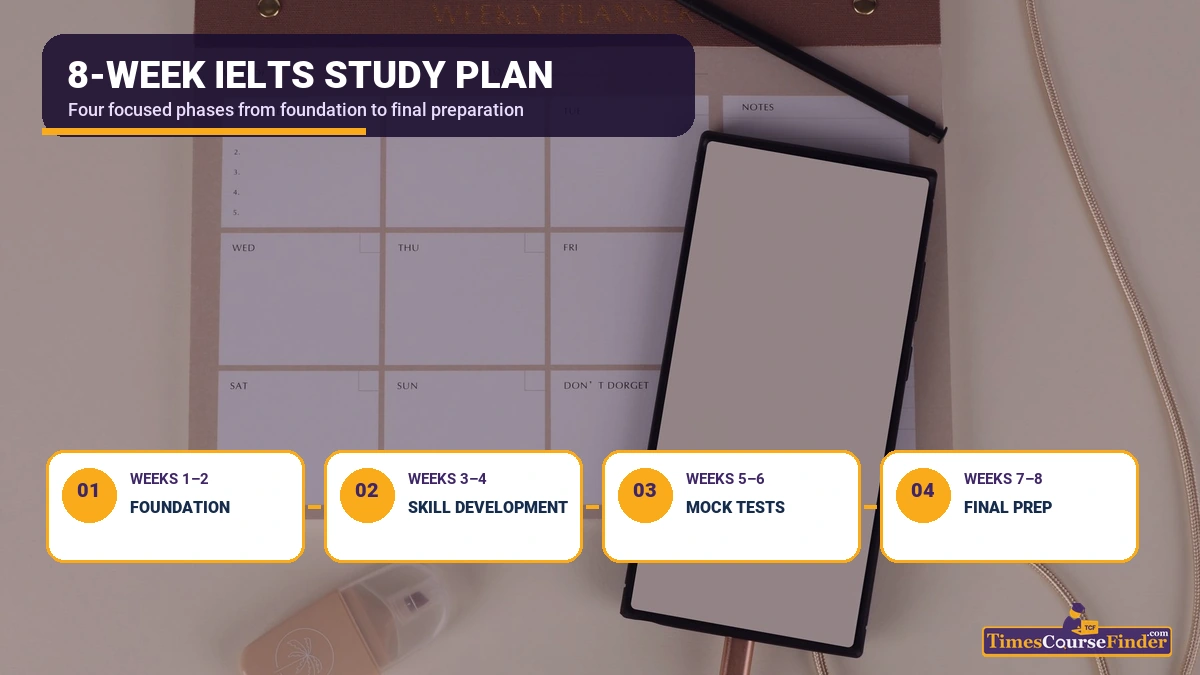
This structured plan builds strong fundamentals, develops all four skills, and gets you test-ready with confidence.
Weeks 1-2: Foundation Building
Focus: understand the IELTS format and strengthen basic English.
|
Day |
Study focus |
|
Day 1 |
Understand the test structure and band scoring |
|
Day 2 |
Listening basics (Section 1 practice) |
|
Day 3 |
Reading basics (skimming and scanning) |
|
Day 4 |
Writing Task 1 introduction |
|
Day 5 |
Writing Task 2 basic essay structure |
|
Day 6 |
Speaking Part 1 practice (intro questions) |
|
Day 7 |
Review and vocabulary building |
In Week 2, add short daily Listening audio, timed basic Reading passages, sentence and essay-structure practice, and daily self-recorded Speaking.
Weeks 3-4: Skill Development
Focus: accuracy, grammar, and time management. Practise Listening Sections 2 to 3, Reading True/False/Not Given questions, Task 1 charts and Task 2 essays, and Speaking Part 2 cue cards.
Weeks 5-6: Mock Tests and Refinement
Move to full test practice under exam conditions: a full Listening test with review, a Reading test with analysis, timed Writing Task 1 and Task 2, a Speaking mock, then a full practice test, followed by weak-area work and vocabulary and grammar revision.
Weeks 7-8: Final Preparation and Confidence
Polish exam strategy. Do real exam-level Listening daily, speed-plus-accuracy Reading, full timed essays, and mock Speaking interviews with feedback. Final tips: practise at the same time of day as your real exam, avoid learning new topics in the last week, focus on accuracy over speed, stay consistent, and simulate exam conditions at least 3 to 4 times.
You can turn this roadmap into a daily checklist by downloading the free TCF IELTS 8-week planner, and take a free full-length mock test to see where your band stands. When you want a second opinion on your plan, book free counselling.
IELTS Listening: Overcoming the Accent Challenge
Listening often feels like the hardest module for Pakistani students, not because of grammar, but because of accents and speed. You cannot fix this with 2 to 3 tests; you need daily exposure.
Why British and Australian Accents Are Hard
- School exposure: most students hear a mix of Pakistani and American-style English, with little natural British or Australian speech.
- Connected speech: native speakers join words ("gonna", "wanna", "kind of"), which does not match dictionary pronunciation.
- Numbers and dates: British speakers say them differently ("nought" for zero, "twenty twenty-six").
- Background noise: IELTS recordings include mild noise that can confuse students used to ultra-clear audio.
Daily Accent Exposure Strategy
Aim for at least 30 minutes of clear listening daily, outside your test practice. A simple routine: 10 minutes passive listening to a British or Australian podcast while doing small tasks; 15 minutes active listening with a transcript (listen, then read, then repeat aloud); and 10 to 15 minutes of one IELTS-style section, checking exactly where you lost marks.
Free Podcasts and YouTube Channels
For a British accent, BBC Learning English and BBC 6 Minute English (with transcripts) are ideal, along with IELTS-specific channels taught by British teachers. For mixed accents, official IELTS sample materials and Australian university student vlogs help you follow real, casual speech. Do not just play and forget: pause, repeat, and shadow-speak along with the speaker to copy the rhythm and stress.
IELTS Reading: Time Management and Strategy
Reading is where many students lose easy marks, not because the passages are impossible, but because time slips away. With three long passages in 60 minutes, you need a clear system for skimming, scanning, and allocating time.
Skimming and Scanning
Skim when you first meet a passage to grasp the topic and structure: read the title and subheadings, then the first sentence of each paragraph, letting your eyes move quickly over the rest. It takes 2 to 3 minutes and tells you where information sits. Scan when a question asks about a specific name, number, date, or keyword: note the keyword, move your eyes quickly down the passage for it or its synonyms, then slow down and read the nearby sentences carefully.
Time Allocation Across the Three Passages
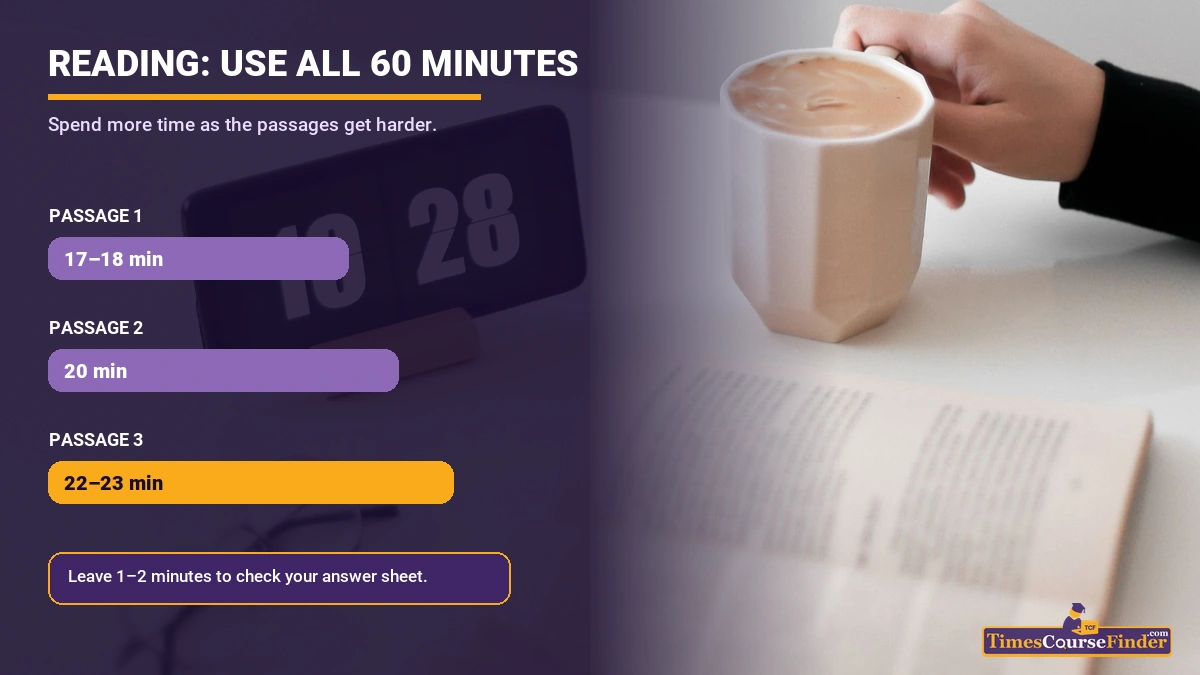
You get 60 minutes for 3 passages and 40 questions. Do not split it into three equal blocks; the passages get harder, so save extra time for Passage 3: roughly 17 to 18 minutes for Passage 1 (easiest), about 20 minutes for Passage 2, and 22 to 23 minutes for Passage 3 (hardest). Two golden rules: if you are stuck on a question for more than 60 to 90 seconds, guess, mark it, and move on; and always practise with a strict timer so your sense of timing is right on test day.
IELTS Writing: Task 1 and Task 2 Mastery
Writing is usually the lowest module for Pakistani students aiming for Band 7. The gap between Band 6 and Band 7 is usually about structure, clarity, and task response, not fancy vocabulary.
Understanding the Band Descriptors
Examiners score four criteria: Task Achievement or Task Response (did you answer fully and cover all parts?), Coherence and Cohesion (logical paragraphs and clear linking), Lexical Resource (a range of appropriate words, without repetition or wrong word choice), and Grammatical Range and Accuracy (a mix of sentence types with few basic errors). To reach Band 7, address all parts of the task, present a clear position in Task 2, use well-planned paragraphs, and show a range of vocabulary and grammar with relatively few serious errors.
Common Errors Pakistani Students Make
- Memorised introductions like "Nowadays, it is an irrefutable fact that..." that examiners recognise and do not reward.
- Not answering the full question: for example, discussing only one view when asked to discuss both and give an opinion.
- Missing or over-long paragraphs, so the examiner cannot follow your logic.
- Repeating simple words ("very", "a lot", "good", "bad") with no topic-specific vocabulary.
- Grammar slips: subject-verb agreement, articles, and tenses.
- No clear overview in Task 1 (Academic): describing every detail but forgetting the summary of main trends.
- Letters (General Training): wrong tone or not covering all the bullet points.
What Makes an Essay Band 7+
Rather than copying full essays, learn the structure. A Band 7+ Task 2 opinion essay paraphrases the question in the introduction and states a clear position, gives one body paragraph per view (topic sentence, explanation, example) with logical progression and linking phrases, keeps the discussion balanced, and closes with a short conclusion that restates the position without adding new ideas. A Band 7+ Task 1 (Academic) response paraphrases the prompt, gives a one- or two-sentence overview of the main trends, then describes and compares key features with accurate figures and comparative language ("rose by", "was higher than", "declined gradually"), without listing every data point.
IELTS Speaking: Building Confidence Past Cultural Hesitation
Many Pakistani students know enough English for a Band 7 in Speaking, but confidence, culture, and habits pull their scores down. The examiner does not need perfect English; they need clear, confident communication for 11 to 14 minutes, and you can train that even if you feel shy right now.
Why Many Students Underperform
The usual causes are limited daily speaking practice, exam anxiety, and a school system that rewards written grammar over communication. Specific patterns include fear of making mistakes, memorised answers that sound rehearsed, passive vocabulary that is hard to use in real time, weak fluency with frequent pauses, and mentally translating from Urdu, which slows responses.
Common Speaking Mistakes
|
Mistake |
Impact |
|
Giving very short answers |
Reduces the fluency score |
|
Using overly complex vocabulary unnaturally |
Sounds forced and confusing |
|
Speaking too fast |
Causes pronunciation and grammar mistakes |
|
Taking long pauses |
Lowers fluency |
|
Memorising templates |
Makes answers sound robotic |
The Cue Card Strategy That Works
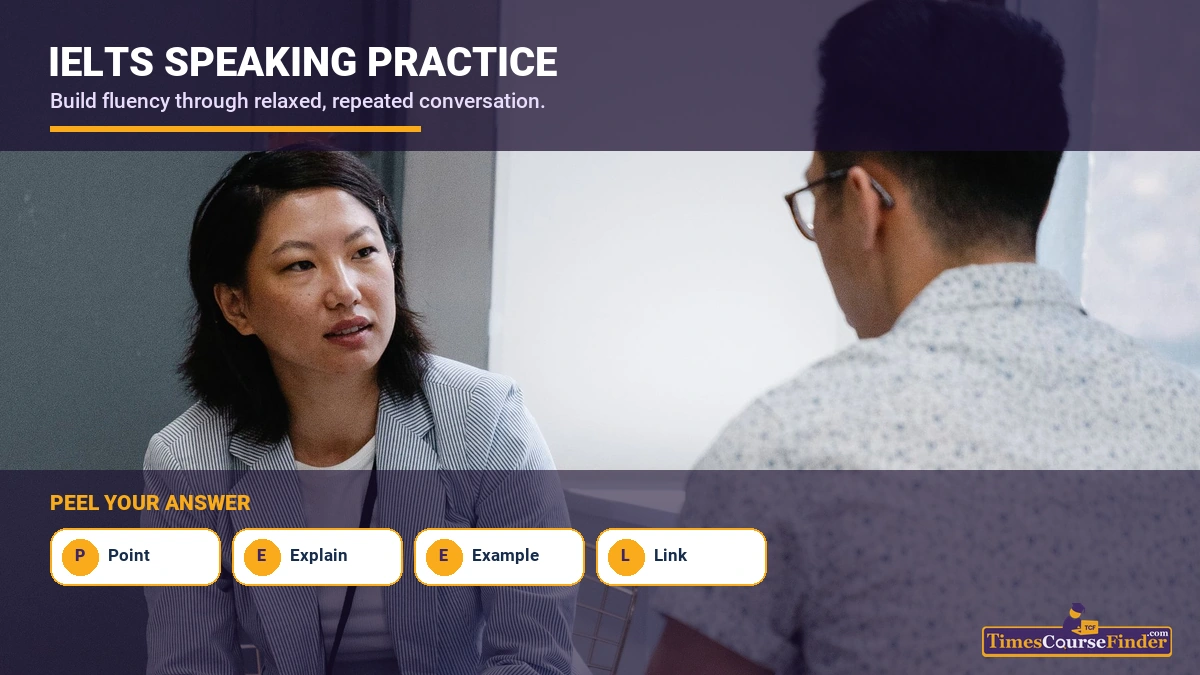
The cue card tests whether you can speak for 1 to 2 minutes on a topic. Read the topic and identify the main subject, note the bullet points, use the one-minute prep to jot short keywords (not full sentences), follow a simple beginning-middle-end structure, keep speaking through small mistakes, and add feelings and details naturally. A reliable frame for each point is PEEL: Point, Explain, Example, Link.
Finding a Speaking Partner (in Pakistan and Online)
You will not build real confidence without speaking to real people. In Pakistan, set a "no Urdu" rule with classmates or friends for 15 to 20 minutes daily, or use a local academy's mock speaking sessions as performance practice. Online, use language-exchange apps and Pakistani IELTS groups to find serious partners, and schedule regular calls 3 to 4 times a week. Record some sessions, note your filler words ("like", "actually"), and aim for longer answers: 3 to 4 sentences for Part 1, a full 2 minutes for Part 2, and 4 to 5 sentences for Part 3.
Free Resources Every Pakistani IELTS Student Should Know
You do not need to spend heavily. Use the official IELTS websites (IDP and British Council) for free practice tests, sample questions, and scoring videos; official Cambridge sample materials for realistic timed mocks; free video lessons from experienced IELTS teachers; and news sites and podcasts with transcripts for listening and reading. If you cannot afford coaching at all, the full IELTS without coaching self-study plan lists more Pakistan-accessible free tools.
Mock Test Schedule for the Final Two Weeks
In the last two weeks, shift from learning new things to stabilising performance and controlling stress. For most students aiming for Band 7, 2 to 3 full mocks per week is ideal; more often causes burnout. In Week 7, alternate full exam-simulation days (Listening and Reading back to back, then Writing Task 1 and 2 in 60 minutes, plus evening Speaking) with review days where you spend 60 to 90 minutes analysing mistakes and rewriting your weakest paragraph, then a lighter skills-polishing day, and finish the week with a rest day. In Week 8 (test week), keep it light: one optional final full mock only if your exam is still 3 to 4 days away, then targeted tune-ups on your weakest module, a light all-skills rotation, and early nights before the test.
Test Day Checklist and What to Expect
The Night Before
- Your valid identity document (usually your passport); check the expiry date.
- Your test booking confirmation and venue, printed or saved clearly on your phone.
- Directions and travel time to the centre, with extra time for traffic.
- A transparent water bottle if your centre allows it, and comfortable clothes (test rooms can be cool).
- An early night and a light evening meal.
Because IELTS in Pakistan is now computer-delivered, you do not need to bring stationery; the centre provides a pen and scratch paper for notes, and you type your answers on screen.
On Test Day
Arrive at least 45 to 60 minutes early. Staff will check your ID, take your photo and fingerprints, and explain lockers, allowed items, and your candidate number. You sit Listening, Reading, and Writing in one continuous block with short transitions rather than long breaks, so follow the timing instructions carefully. The Speaking test may be the same day or a different day; you wait outside the room until the examiner calls you, and it lasts about 11 to 14 minutes across Part 1, the Part 2 cue card, and Part 3 discussion.
Conclusion
You now have a clear, Pakistan-specific roadmap to Band 7 in 8 weeks through focused self-study. The smartest next step is to act on it rather than save another article: download the free TCF IELTS 8-week planner to turn these weekly goals into daily tasks, then take a free mock test through TCF's search and comparison platform for an honest snapshot of your current band. If IELTS is not the right test for you, check whether you can study abroad without IELTS.
Simplified Step By Step
Fill in for a call-back within 24 hours
Student Reviews
Based on 0 approved reviews
No reviews yet — be the first!