



IELTS Without Coaching: A Pakistani Student's Self-Study Success Plan (Free Resources)
A free, Pakistan-specific IELTS self-study plan: who should self-study, free resources, a 6-week schedule, daily routine, mock strategy, and speaking partners.
 Team TCF
Preparing for IELTS without an organised plan is risky, but coaching is not the only route. If you are a student or job-holder trying to prepare for IELTS at home in Pakistan, you can build a solid self-study plan with free online resources, official practice tests, and a realistic daily routine instead of expensive classes. You do not need shortcuts or leaked papers; you need a focused strategy for Listening, Reading, Writing, and Speaking that fits your goals. If you have not yet chosen your test, compare your options in the IELTS vs PTE vs TOEFL guide.
This blueprint shows you how to prepare for IELTS in Pakistan without coaching, where to find free online resources, and how to track your progress from Band 5.5 to 6 up to Band 7 and beyond, using tools that are genuinely accessible to Pakistani students.
Self-Study Is Absolutely Possible (Mindset Reset)
You can prepare for IELTS at home in Pakistan and do well if you treat self-study like a serious project. You already have what you need: a smartphone or laptop, internet, and a clear plan. Many Pakistani students quietly reach Band 7 without coaching because they stay consistent, use official materials, and stop chasing shortcuts. The real difference is between random study and planned study.
Why Many Pakistani Students Underestimate Self-Study
- They assume more fees means better results.
- YouTube and social media create confusion with too many conflicting tips, so self-study feels messy.
- Social pressure pushes them toward famous centres instead of a proper plan at home.
Who Should Not Self-Study (Band 5 or Below)
Self-study is powerful, but it does not fit everyone. Some students should avoid going fully solo at the start:
- If your current level is around Band 5 or below and you struggle to understand English videos, basic articles, or everyday conversations, a foundational gap in grammar and vocabulary will hold you back.
- If you cannot write a simple paragraph without major mistakes in every sentence, you need guidance.
- If you open an IELTS Reading passage or listening recording and cannot catch even the general meaning, you need a teacher or coach first.
For these students, a hybrid approach works best: use a local tutor, an online course, or a small group to fix the basics, then switch to focused self-study once you reach around Band 5.5 to 6.
Free Resources Every Pakistani IELTS Self-Studier Needs
You can build a strong self-study plan with free, high-quality resources if you know where to look. You do not need bundles of links; you need a small toolkit you use every day.
YouTube Channels (E2 IELTS, IELTS Liz, Fastrack IELTS)
- E2 IELTS: clear strategies for all four modules, especially Writing and Speaking, and how the examiner thinks.
- IELTS Liz: very strong on Writing Task 1 and Task 2 and Speaking ideas, in short focused videos.
- Fastrack IELTS: practical tips, model answers, and step-by-step breakdowns.
Pick one main channel per module (for example, E2 for Writing, Liz for Speaking) and stick with it rather than jumping between ten teachers a day.
Websites (IELTS.org, British Council LearnEnglish)
- IELTS.org and the official IELTS pages: test format, band descriptors, sample questions, and official guidance. Use them to confirm how IELTS really works.
- British Council LearnEnglish and IELTS preparation sections: free practice for grammar, vocabulary, and all four skills, designed by exam experts.
Apps (BBC Learning English, IELTS Apps)
- BBC Learning English: daily audio and video lessons with British accents; short programmes like 6 Minute English train listening and natural vocabulary.
- IELTS-focused apps: quick revision of question types, phrases, and mini-quizzes. Set a daily 15-minute app slot rather than using them randomly.
Free Practice Tests
You cannot do IELTS self-study without full practice tests to check your level. Use official-style tests that mirror the real layout and timing, do at least one full test every 2 to 3 weeks (increasing in the final month), and spend more time analysing mistakes than doing new questions: ask why you chose the wrong option, and whether you misunderstood the vocabulary, the question, or the audio. Treat practice tests as your progress report, not a random activity.
The 6-Week Self-Study Schedule
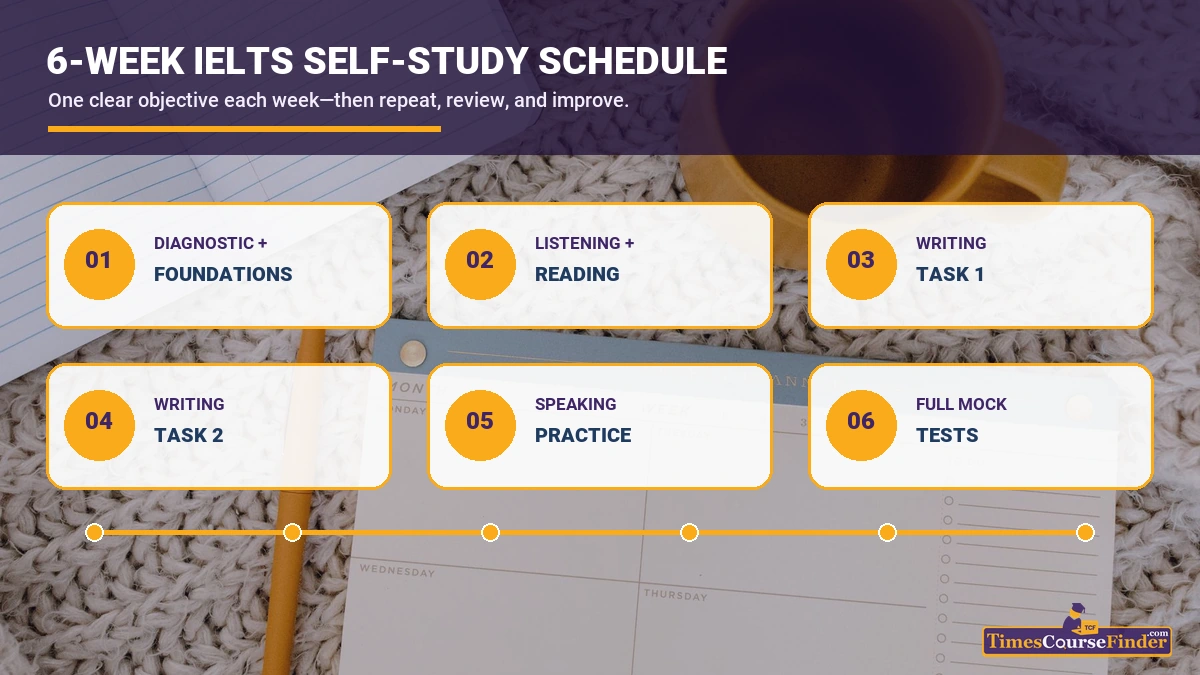
This 6-week schedule suits students aiming for Band 6.5 to 7.5 through consistent daily practice of 2 to 3 hours.
Week 1: Diagnostic and Foundations
Take one full practice test (or at least one Listening, one Reading, and one Writing Task 2), note rough bands, and list weaknesses. Then spend Days 3 to 5 on grammar (tenses, subject-verb agreement, articles), one untimed Reading passage a day for understanding, and one Listening section a day with replay and analysis. On Days 6 to 7, write one Task 2 essay and one short Task 1 or letter, and answer ten simple Speaking Part 1 questions while recording yourself.
Week 2: Listening and Reading Focus
Build strong habits for the two most technical skills across 5 to 6 days: 45 minutes of Listening (one full section with timing, then review vocabulary and replay problem parts), 45 minutes of Reading (one passage with an 18 to 20 minute timer, skimming first then scanning), and 30 minutes of topic-wise vocabulary with your own example sentences.
Week 3: Writing Task 1 Mastery
Over 4 to 5 days, study one model answer for structure (20 minutes), write one Task 1 under 20 minutes (40 minutes), and rewrite the previous day's answer (20 minutes). For Academic, learn to write an overview, comparisons, and trends; for General Training, practise formal, semi-formal, and informal letters with the right tone. Keep 30 minutes of Reading or Listening on alternate days so those skills do not drop.
Week 4: Writing Task 2 Mastery
Over 5 to 6 days, learn one clear structure for Opinion and Discussion essays and write one essay a day in 40 minutes, then add Problem-Solution and Advantages-Disadvantages types, and finally rewrite an older essay with stronger topic sentences, examples, and linking words. By the end of the week you should be able to start any Task 2 question and write at least 250 words with a clear structure.
Week 5: Speaking Practice
Plan 5 to 6 short sessions of 20 to 30 minutes. Days 1 to 2: answer 15 to 20 simple Part 1 questions, record yourself, and check grammar, repetition, and pauses. Days 3 to 4: practise Part 2 cue cards with a fixed four-part structure (intro, background, main story, opinion), speaking for a full 2 minutes. Days 5 to 6: answer 8 to 10 deeper Part 3 questions, focusing on reasons and examples rather than one-line answers.
Week 6: Mock Tests and Refinement
Do at least 2 full mock tests this week (Listening and Reading back to back, Writing Task 1 and 2 in 60 minutes, and short Speaking later the same day). On non-mock days, spend 45 minutes on your weakest skill, 30 minutes revising vocabulary and common mistakes, and 20 to 30 minutes on one light extra task. By the end you will know your realistic band range, have a clear list of personal errors, and feel confident handling IELTS with a home-based plan.
Daily 3-Hour Schedule
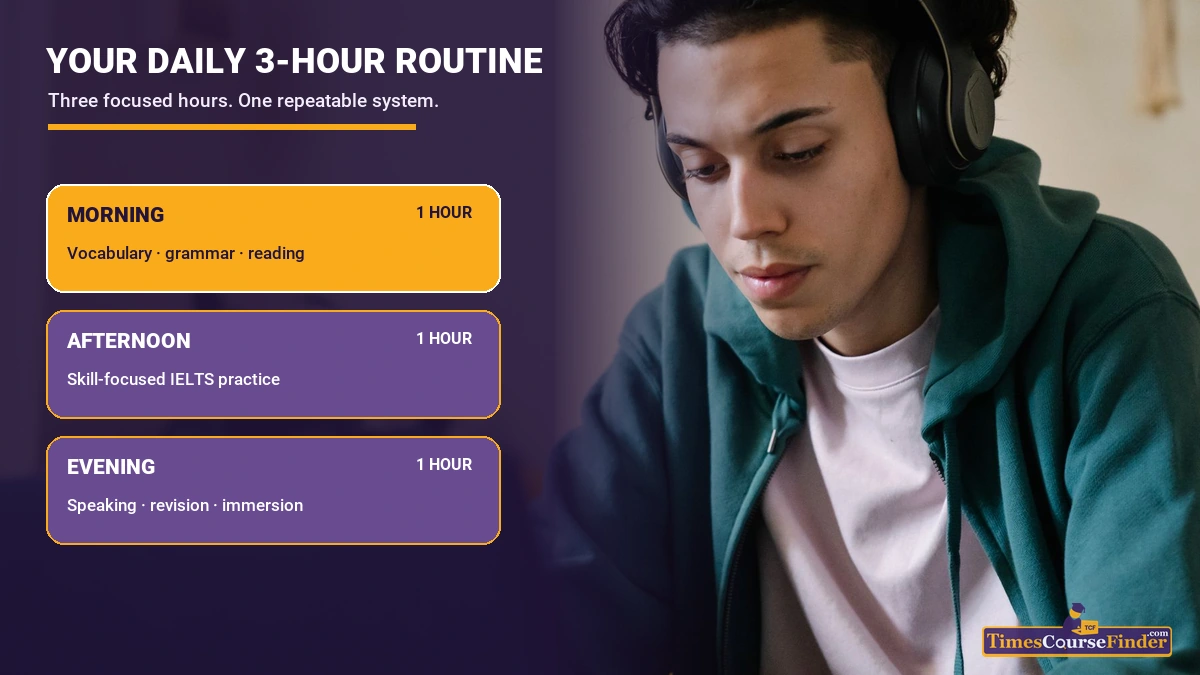
Use this as a flexible template. Shift the blocks around your college or job, but try to keep three focused one-hour sessions.
|
Session |
Focus |
|
Morning (1 hour) |
Vocabulary (10 to 15 new words), grammar review, read an article, and summarise it |
|
Afternoon (1 hour) |
One IELTS module under timed conditions, rotating by day (Listening, Reading, Writing Task 1, Writing Task 2, Speaking, review, mini mock) |
|
Evening (1 hour) |
Speaking or cue-card practice, review of earlier mistakes, and English immersion (podcast, interview, or talk) |
The benefit of splitting the day this way is balanced coverage of all four skills, less burnout from short focused blocks, easier long-term consistency, better retention through regular revision, and steady practice at exam timing.
Weekly Mock Test Strategy
One good mock each week turns theory into real progress: it shows your true band range and tells you exactly what to fix next. Find free official-style mocks on the official IELTS websites, British Council and IDP practice hubs, Cambridge IELTS books, reputable apps, and guided YouTube mock tests. Time yourself strictly (Listening 30 minutes, Reading 60 minutes, Writing 60 minutes, Speaking 11 to 14 minutes) with no extra breaks and no checking answers mid-test. Then self-grade: for Listening and Reading, use the answer key and convert your raw score to an estimated band; for Writing, score yourself against the four criteria (Task Achievement, Coherence and Cohesion, Lexical Resource, Grammar); and for Speaking, record yourself and assess fluency, vocabulary, grammar, and pronunciation.
Finding a Speaking Partner

Real speaking practice with people, not just the mirror, is what builds fluency. You need partners for 15 to 30 minutes several times a week.
- Facebook IELTS Pakistan groups: search "IELTS Pakistan", "IELTS Speaking Partners Pakistan", or your city plus IELTS, and post your target band, preferred time, and platform. Share personal details only in private messages.
- Language-exchange apps such as Tandem: set your profile as native Urdu, learning English, mention you are preparing for IELTS, and filter for patient partners who use voice messages or calls.
- Discord IELTS servers: join voice rooms where people practise Speaking parts, and use servers that run mock speaking sessions to get used to speaking in front of strangers.
- Family and friends: if apps feel intimidating at first, ask a sibling, cousin, or friend for 15 minutes of English daily with a no-Urdu rule and IELTS-style questions. Even if their English is below yours, speaking aloud daily breaks shyness.
When you practise, record some sessions, note your filler words ("like", "actually"), and aim for longer answers: 3 to 4 sentences for Part 1, a full 2 minutes for Part 2, and 4 to 5 sentences for Part 3.
Writing Evaluation Options
Unlike Listening and Reading, Writing has no answer key, so feedback is what helps you improve structure and understand what examiners reward.
|
Free option |
Benefit |
Limitation |
|
Study partners / peer review |
Fresh perspective and feedback |
May lack IELTS expertise |
|
IELTS study groups |
Community feedback and suggestions |
Quality varies |
|
AI writing tools |
Quick grammar and structure checks |
Cannot accurately predict an IELTS band |
|
Self-assessment with band descriptors |
Helps you internalise examiner criteria |
Requires practice and honesty |
|
Online IELTS forums |
Feedback from experienced candidates |
Not always reliable |
Use AI tools for grammar correction, sentence clarity, vocabulary suggestions, and spotting repetitive language, but not for a band estimate. For students aiming at Band 7+ or competitive universities, paid feedback (for example, Write to Top, IELTS Liz premium lessons, or a professional tutor for one-to-one essay evaluation) can be a worthwhile investment.
Building Vocabulary Naturally
You do not need fancy books, just daily contact with real English plus a simple system to capture and reuse new words. Natural vocabulary building helps you remember phrases, speak more confidently, and avoid the robotic style examiners dislike.
Reading Habits
Read short, real texts every day (news sites, technology blogs, health and education articles), aiming for one or two articles or 15 to 20 minutes. Use a simple 3-3-1 rule: choose three useful words or phrases, write three of your own example sentences, and use at least one of them in your speaking or writing that same day. Mix easy sources (learner news), medium (opinion pieces), and difficult (academic-style texts like IELTS Reading).
Word Lists vs Context Learning
Pure word lists help only if you connect them to real sentences. Instead of memorising "mitigate = reduce", see the word inside a sentence while reading or listening, then write your own sentence. Keep a small notebook or digital note with one page per topic (education, technology, environment, health), each word with a simple meaning in your own words and one or two example sentences.
Pakistani-Specific Vocabulary Gaps
Many Pakistani students struggle to lift their band not because they lack vocabulary, but because of the gap between everyday English and academic English. Some common upgrades:
|
Common usage |
Better IELTS alternative |
|
"Very good" |
Excellent, outstanding, highly regarded |
|
"Many students" |
A large number of students, numerous students |
|
"Big problem" |
Major issue, significant challenge |
|
"Good for students" |
Beneficial for students |
|
"Nowadays" (overused) |
Currently, in recent years, at present |
|
"Bad effects" |
Negative impacts, adverse consequences |
|
"More and more" |
Increasingly, a growing number of |
|
"Rich countries" |
Developed nations, high-income countries |
Close the gap by reading English news daily, learning words in context, keeping a vocabulary notebook, using new words in speaking and writing, and learning collocations so your English sounds natural.
Common Self-Study Mistakes
Most students who stay stuck at Band 6 make the same predictable mistakes, not because they are weak, but because they study without a clear strategy.
Memorising Essays
The real question never matches your memorised essay, examiners recognise copy-paste templates, and you panic if the topic differs. Instead, memorise structures, not full essays: how to write a two-sentence introduction, how to build a body paragraph (topic sentence, explanation, example), and how to close briefly, then practise turning new questions into quick outlines in five minutes.
Not Timing Yourself
The real exam never gives you extra time, and untimed practice leaves you rushing or leaving questions blank on the day. Use a timer for almost all practice after Week 1: 60 minutes for three Reading passages, 20 minutes for Task 1 and 40 minutes for Task 2, and never pause the recording in Listening mocks.
Ignoring Band Descriptors
Band descriptors are the marking scheme, yet many self-studiers never read them, so they chase fancy vocabulary while the exam rewards clarity, coherence, and accuracy. Read simplified descriptors for Writing and Speaking at least once a month, turn them into a checklist (did I answer all parts? does each paragraph have one clear idea? did I use a range of vocabulary? are my sentences mostly error-free?), and score yourself against the four criteria after each essay or recording.
Skipping Speaking Practice
Shyness does not disappear on its own, and knowing grammar is not the same as using it in real time. Set a minimum of 15 to 30 minutes of English speaking 4 to 5 days a week, mixing mirror practice, partner practice, and recorded monologues, and focus on length and clarity: 3 to 4 sentences for Part 1, a full 2 minutes for Part 2, and 4 to 5 sentences with reasons and examples for Part 3.
When to Consider Hiring Help
Self-study works, but a smart student knows when to bring in a teacher for a boost. Think of coaching as a tactical upgrade, not a default starting point.
Signs You Need Coaching
- You stay stuck at the same band.
- You cannot see your own mistakes.
- You panic in timed conditions.
- Your basics are weak, especially below Band 5.5.
- You feel burnt out or lost.
The Hybrid Approach
You do not have to choose between "only academy" and "only self-study". Use self-study for learning the format and strategies, daily Listening, Reading, and vocabulary, and regular Speaking practice; use targeted coaching for detailed Writing feedback once or twice a week, a few mock Speaking tests with a teacher, and short focused courses on your weakest skill. This keeps costs down and leaves you in charge of your pace. If you hit your target in mocks with self-study alone, you may never need paid help; if you keep hitting a wall, a hybrid strategy can be the difference between "almost Band 7" and actually achieving it.
Recommended Self-Study Resources
A quick reference toolkit. In the CMS, link each resource to its official page.
|
Category |
Resource |
Best for |
How to use it |
|
YouTube |
E2 IELTS |
Strategies for all 4 modules |
One focused video a day, then apply it in practice |
|
YouTube |
IELTS Liz |
Writing Task 1 and 2, Speaking ideas |
Learn structures, then write your own answers |
|
YouTube |
Fastrack IELTS |
Fast tips and model answers |
Use before mocks to refine technique |
|
Website |
IELTS.org |
Test format, sample questions |
Confirm format and question types |
|
Website |
British Council LearnEnglish |
Grammar, vocabulary, skills practice |
Short daily exercises alongside your plan |
|
App |
BBC Learning English |
Daily listening and vocabulary (British accent) |
10 to 15 minutes daily on the go |
|
App |
IELTS prep app |
Question types, mini-tests |
Quick revision in spare time |
|
Practice tests |
Official-style mock tests |
Full exam simulation |
One weekly mock plus detailed review |
|
Speaking |
Facebook IELTS groups |
Finding Pakistani speaking partners |
2 to 3 short calls per week |
|
Speaking |
Language-exchange apps |
Foreign partners, accent exposure |
15 to 30 minute sessions, 2 to 3 times weekly |
Bottom Line
You now have a complete, Pakistan-specific roadmap to prepare for IELTS, from free resources and daily schedules to weekly mocks and speaking partners. Download the IELTS self-study toolkit from TCF to turn these strategies into a day-by-day checklist, then book a free counselling session to align your test date, target band, and study-abroad options. If you want the full 8-week version with a test-day walkthrough, see the IELTS preparation guide, and if tests are a real barrier, check whether you can study abroad without IELTS.
Simplified Step By Step
Fill in for a call-back within 24 hours
Student Reviews
Based on 0 approved reviews
No reviews yet — be the first!