



Study Abroad Without IELTS: 8 Countries Pakistani Students Can Apply To
Study abroad without IELTS from Pakistan: 8 countries, how MOI letters and university tests work, the honest MBBS picture, and IELTS alternatives.
 Team TCF
Most of us assume studying abroad is impossible without IELTS, or at least a 6.5. If you are a Pakistani student who is anxious about English tests, tired of repeated attempts, or simply running out of time, there is another path. Some countries, universities, and scholarship programmes will look at your school English marks, a medium-of-instruction letter, or their own internal test instead of IELTS.
This guide is for you, and for parents who want clear, honest answers. You will see no-IELTS universities, options to study in Europe without IELTS, and where MBBS without IELTS from Pakistan might be possible through foundation routes or alternative English proof.
What follows is a country-by-country breakdown of 8 realistic destinations, the routes that replace IELTS, and the checks you must run so you do not get caught out at the visa stage. These are real options that thousands of students use, not a magic shortcut.
Can You Really Study Abroad Without IELTS?
Yes, in many cases Pakistani students can study abroad without IELTS, but it is never a magic hack where every rule disappears. Some universities, and even some countries, are happy to consider you if you can prove your English another way:
- A Medium of Instruction (MOI) letter showing that your previous degree was fully taught in English.
- A university internal English test, taken online or on campus.
- An alternative test such as PTE, Duolingo, or a country-specific exam.
For Pakistani students, this usually works best for bachelor's and master's programmes in parts of Europe, the UK (selected universities), Turkey, China, Germany, and some scholarship routes where the university or government sets its own English requirement.
The big warning is that admission rules and visa rules are not always the same. A university might admit you without IELTS using MOI, but the embassy could still ask for a formal English test for the visa. So studying abroad without IELTS is not a dream, but you must check both the university side and the immigration side before you apply.
How MOI Letters and University Tests Work
A Medium of Instruction (MOI) letter is a simple official letter from your school, college, or university saying that your classes, exams, and books were in English. For many no-IELTS routes, this is the key document that replaces a test score. A typical MOI letter:
- Is on the official letterhead of your college or university.
- States your name, programme, and study years.
- Clearly says the entire programme was taught in English.
- Carries an official stamp and signature.
Some UK and European universities and a few scholarship programmes accept MOI from recognised Pakistani institutions as proof of English and grant an IELTS waiver if your grades and English marks meet their cut-offs. In other cases, universities invite you to sit their own online English test or interview instead of IELTS, and decide based on that result.
Think of it like this: IELTS is a global exam ticket, while MOI and university tests are more like direct permission from the university itself. Both can work, but MOI and internal-test routes are usually more limited and change faster, so double-check the latest rules for your target course and country.
8 Countries and Routes That Waive IELTS
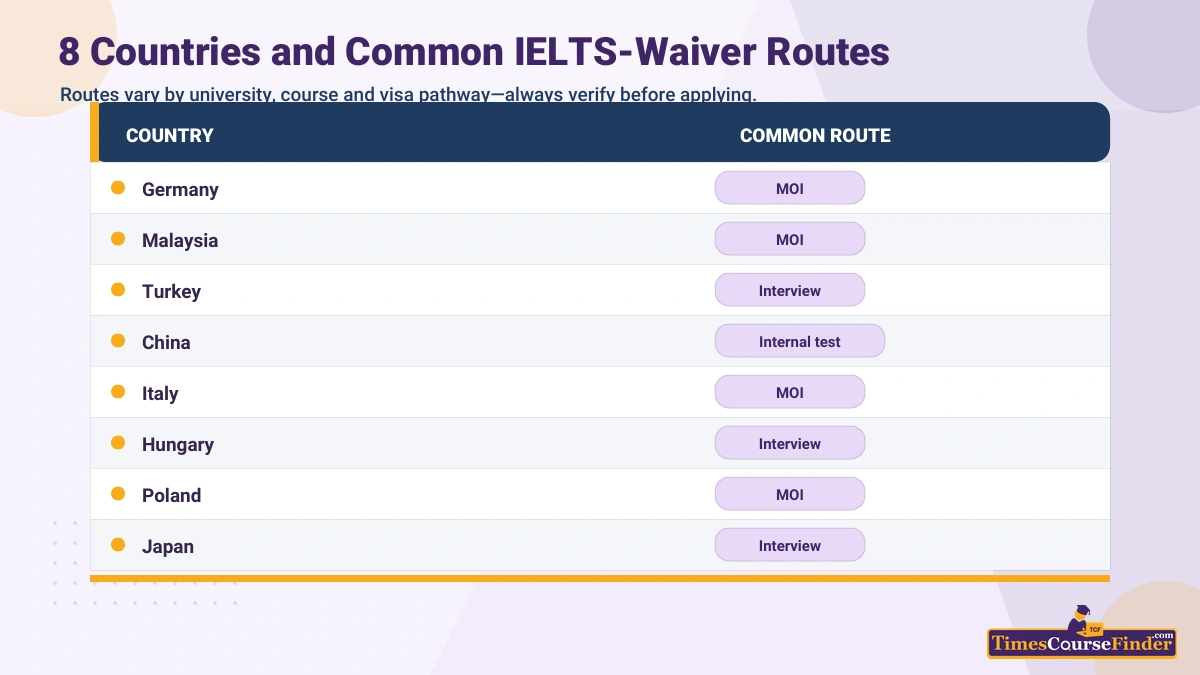
Below are 8 realistic countries where Pakistani students can often apply without IELTS, depending on the university, course, and visa route. Sometimes you skip IELTS completely; other times you skip IELTS but still show English through MOI, an internal test, or an interview.
|
Country |
No-IELTS Route |
What Pakistani Students Should Know |
|
Germany |
MOI letter, TOEFL/PTE/Duolingo, or German-taught route |
Strong option for public universities and English-taught master's programmes, but acceptance is university-specific. |
|
Malaysia |
MOI letter, internal placement test, university English assessment |
One of the most practical, low-cost options; many private universities are flexible on English proficiency. |
|
Turkey |
University English proficiency exam, TOEFL at some universities, Turkish-taught route |
Some English-taught programmes are strict; others allow internal testing or Turkish-medium admission. |
|
China |
MOI letter, university interview or test, preparatory English courses |
A number of universities accept alternative English proof, especially for selected scholarships or English-medium programmes. |
|
Italy |
MOI letter, university waiver, alternative English proof |
Many universities consider MOI for English-taught master's programmes, but verify the exact faculty-level requirement. |
|
Hungary |
MOI letter, online interview, internal English evaluation |
Often flexible for international applicants, especially at the admission stage. |
|
Poland |
MOI letter, university interview, alternative test |
Some institutions accept proof of prior English-medium study instead of IELTS. |
|
Japan |
MOI letter, TOEFL/PTE alternative, university screening |
More common at graduate level and scholarship-linked routes than at every university. |
Several of these are full TCF destination guides in their own right: Germany, Malaysia, Turkey, China, and Italy.
Germany, Malaysia, Turkey, China and Others
Here is the practical breakdown of how these no-IELTS routes usually work.
|
Country |
Common Waiver Route |
Best Fit For |
|
Germany |
MOI letter if your previous degree was taught in English; some universities also accept TOEFL, PTE, Duolingo, or German for German-taught courses |
Students targeting public universities, low tuition, and English-taught master's programmes |
|
Malaysia |
MOI, internal placement test, or English preparation course |
Students looking for affordable tuition, simpler admission, and English-medium study in Asia |
|
Turkey |
University proficiency exam, TOEFL at some universities, or Turkish-medium admission |
Students open to both English- and Turkish-taught programmes |
|
China |
MOI, interview, internal English assessment, or foundation route |
Students considering scholarships, medicine, engineering, and affordable Asian options |
|
Italy |
MOI or faculty-approved waiver |
Students targeting public universities and scholarship-friendly options in Europe |
|
Hungary |
Interview or MOI |
Students looking for Central European options and scholarship routes |
|
Poland |
MOI or internal evaluation |
Students wanting lower-cost EU options |
|
Japan |
Alternative English proof or university review |
Students applying for graduate study, research, or selected international programmes |
What "Without IELTS" Usually Means in Practice
For Pakistani students, these are the four main routes that replace IELTS:
|
Route |
What It Means |
|
MOI (Medium of Instruction) letter |
A letter from your school, college, or university confirming your previous studies were taught in English |
|
Alternative test |
The university accepts TOEFL, PTE, Duolingo, Cambridge, or another approved test instead of IELTS |
|
Internal university test or interview |
The university checks your English through its own placement test or interview |
|
Pathway or English-prep route |
You receive admission first and complete an English preparation course before the main degree |
For each of these routes, you must check both the university rules and the scholarship or visa rules at every step, not just one of them.
MBBS Without IELTS: The Honest Picture
For Pakistani students, MBBS without IELTS is possible in some countries, but not in the way it is often marketed. In medicine, universities are usually more careful about language because clinical training, patient communication, and licensing standards matter far more than in many other degrees. So the real question is not "which country has MBBS without IELTS?" but "which universities accept an alternative proof of English instead of IELTS?"
The honest answer is:
- Yes, some MBBS universities accept students without IELTS.
- But they usually still ask for another form of English proof.
- Countries and universities vary in their rules and in whether the programme is truly English-medium.
What "MBBS Without IELTS" Usually Means
|
Route |
What It Actually Means |
|
MOI (Medium of Instruction) |
Your school or college issues a letter confirming your previous education was taught in English |
|
University English test or interview |
The university checks your English through an internal test or interview instead of IELTS |
|
Alternative test accepted |
Some universities accept TOEFL, Duolingo, or another approved test instead of IELTS |
|
English-medium MBBS with no IELTS requirement |
More common in selected Chinese universities than in Europe |
The Most Important Warning
For MBBS, do not assume that a country being IELTS-waiver friendly for master's or business programmes means the same applies to medicine. Medical admissions are often stricter, and some countries that are flexible for other degrees are much less flexible for MBBS.
Universities Accepting MOI or Their Own English Test
For Pakistani students, the strongest no-IELTS MBBS route is usually through universities that accept either an MOI or school certificate showing your previous education was in English, or their own English screening instead of IELTS.
Where This Is Most Realistic
|
Country / University Type |
What They May Accept Instead of IELTS |
What to Verify Before Applying |
|
Chinese MBBS universities (selected English-medium programmes) |
MOI or school English certificate, or direct academic review |
Whether the university is MOE-listed for English-medium MBBS, whether it is PM&DC-recognised, and whether the programme is fully English-medium rather than partly bilingual |
|
Xiamen University MBBS (verify current policy) |
IELTS/TOEFL/Duolingo, or a certificate showing previous education was fully in English |
Confirm the current intake rule directly, as this is cited as an example of an IELTS alternative rather than a permanent guarantee |
|
Dalian Medical University MBBS (verify current policy) |
English-medium route for international students, alternative English proof |
Verify the current intake rules, PM&DC recognition, and exact documentation at the time of application |
|
Some Turkish private universities |
University English test, preparatory year, or alternative English proof |
Whether the medicine programme is actually in English, and whether IELTS is waived for medicine specifically |
|
Selected Malaysian universities |
MOI or internal English placement in some programmes |
Medicine can be stricter than other subjects, so get written confirmation from the medical faculty |
What to Ask the University Before Applying
|
Question |
Why It Matters |
|
Do you accept an MOI letter instead of IELTS for MBBS? |
Some universities accept MOI for business or engineering, but not for medicine |
|
Is the MBBS programme fully English-medium? |
"English-medium" is sometimes marketed loosely; clinical training may still involve the local language |
|
Is there an internal English test or interview if I do not have IELTS? |
This is often the real no-IELTS route |
|
Is the university recognised by PM&DC, WDOMS, or other relevant bodies? |
This matters for licensing and future practice in Pakistan or elsewhere |
|
Will the visa require separate proof of language even if the university waives IELTS? |
University admission and visa documentation are not always the same |
One more thing on medicine specifically: even after an MBBS abroad, to practise in Pakistan you must have studied at a PM&DC-recognised institution and then clear the National Equivalence Board (NEB) and National Registration Examination (NRE). Plan for that from the start. For the country most Pakistani MBBS students choose, see the China study guide.
|
When You Still Genuinely Need IELTS
Even if you are focused on studying abroad without IELTS, there are clear situations where an official IELTS (or another approved test) is the smartest or only option. Treat these as no-shortcut zones:
- Strict visa rules. Some embassies set their own English-test requirement, separate from the university. Even if a university accepts MOI, the visa officer may still expect an approved score, often IELTS, sometimes PTE or TOEFL. Skipping it can put your visa at risk.
- Regulated professions such as medicine, nursing, and law. Professional councils and licensing bodies often require IELTS or an equivalent for later registration, not just admission. You might join an MBBS without IELTS, then need it later to prove your English for exams or jobs.
- Top and competitive universities. Many higher-ranked universities in the UK, Canada, Australia, and Europe prefer a standardised test for fairness. They may not accept MOI at all, or only from a short approved list of Pakistani institutions.
- Multiple-country plans. If you are undecided between Germany, Canada, the UK, or Australia, a solid IELTS score keeps 3-4 options open at once, whereas MOI and internal tests are usually valid only for specific universities.
Alternatives to IELTS (PTE, TOEFL, Duolingo)
If you struggle with IELTS or simply prefer a different exam style, three alternatives come up again and again: PTE Academic, TOEFL iBT, and the Duolingo English Test. For a full head-to-head, see the IELTS vs PTE vs TOEFL guide.
- PTE Academic (Pearson): fully computer-based, including recorded speaking. Accepted by many universities in the UK, Australia, Canada, and Europe, and for some student visas. Good if you are comfortable typing and prefer not to speak to a human examiner.
- TOEFL iBT: a long-established, computer-based academic test. Widely accepted in the US, Canada, and many other countries, and used for some visa categories. Good if you prefer traditional academic reading and listening passages.
- Duolingo English Test: shorter, cheaper, and taken online from home with strict security checks. Accepted by a growing number of universities, especially in the US, Canada, and parts of Europe, though visa acceptance is more limited.
Quick Comparison: IELTS Alternatives at a Glance
|
Test / Route |
Accepted by universities? |
Accepted for a visa everywhere? |
Good option for Pakistani students? |
|
PTE Academic |
Yes, at many universities |
Depends on the country |
Yes |
|
TOEFL iBT |
Yes, widely accepted |
Often yes, but country-specific |
Yes |
|
Duolingo |
Accepted by selected universities |
Not always preferred for visa documentation |
Sometimes |
A simple decision path for a Pakistani student: for maximum global flexibility (UK, Canada, Australia, Europe), IELTS is still the safest one-size option. If Australia or specific universities are your first choice, PTE Academic may suit you, as long as both the university and visa rules accept it. If you are targeting universities that explicitly accept Duolingo and your visa route does not insist on IELTS, TOEFL, or PTE, Duolingo can be a low-cost, quick alternative.
Whatever you choose, always check all three layers for your path: your university's accepted tests and minimum scores, your scholarship's English rules if applying, and your visa authority's test list and minimums.
Bottom Line
Studying abroad without IELTS is genuinely possible for many Pakistani students, as long as you plan around the university, scholarship, and visa rules together rather than assuming a single waiver covers everything. If you are unsure which country fits your profile and budget, you can compare destinations, tuition, and visa policies on TCF's search and comparison platform, explore scholarships, or book free counselling to map your options.
Simplified Step By Step
Fill in for a call-back within 24 hours
Student Reviews
Based on 0 approved reviews
No reviews yet — be the first!